When it relates to pickup trucks, one question that is really often asked is: How much weight can the truck bed safely carry? Indeed, there is no more correct answer than to comprehend your truck bed dimensions and weight capacity. This figure is the one that you need, the one that tells how much freight can be safely loaded on the bed of the truck without risking damage and/or safety on the road. However, even if it helps you avoid the countless causes of the truck including reduced performance, a higher repair bill, and possibly even legal issues if you exceed the local weight limits.
For instance, construction contractors putting heavy tools on trucks, weekend explorers carrying ATVs, and logistics experts who design load plans for freight all refer to the proper specification of payload capacity, GVWR, curb weight, etc. as their “must-haves”. This guide will focus on the payload calculation process, why overloading is a hazard, and practical hauling techniques that can prevent your truck or cargo from damages.
Factors Influencing Truck Bed Weight Capacity
Gross Vehicle Weight Rating (GVWR)
The Gross Vehicle Weight Rating (GVWR) is the benchmark truck specifications that should be taken into account while assessing weight limits. It is expressed in the total maximum weight a truck is capable of, which includes curb weight, passengers, fuel, cargo, and optional equipment. The GVRW is a value set by engineers based on the truck’s frame capacity, brake performance, suspension durability, and axle capability.
Exceeding GVWR is not only a threat to the safety of the vehicle but also voids the manufacturer’s warranty and can also raise legal issues in case of a crash. This floor load rating must be seen as a ceiling to be hit rather than a mere suggestion.
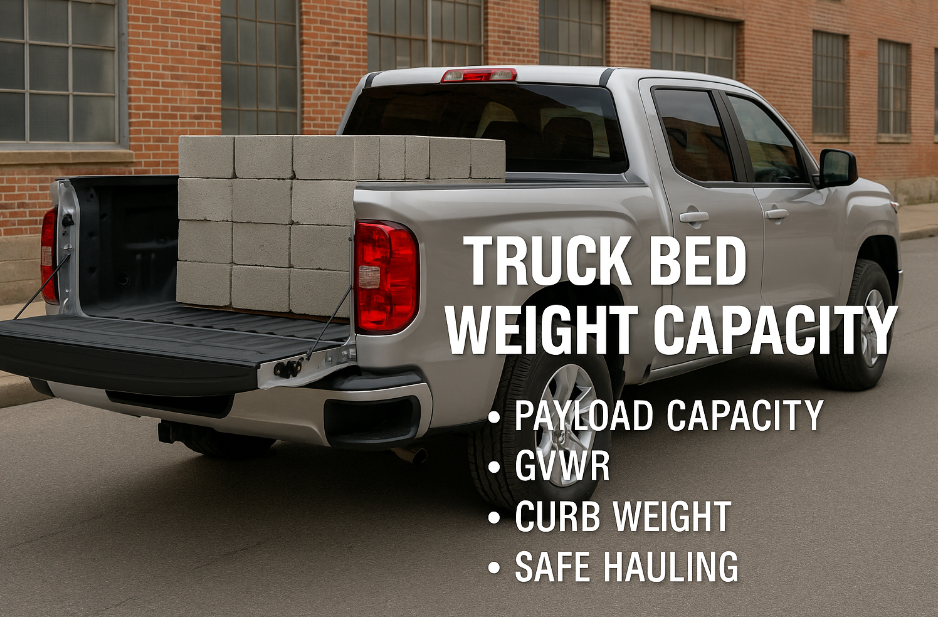
These three specifications—GVWR, curb weight, and payload capacity—work together to define the actual truck bed weight capacity for every model.
Curb Weight
The curb weight of a truck is its weight without passengers or cargo but with all operating fluids. Some truck brands are heavier if the trim packages, four-wheel-drive systems, or large engines are added. Curb weight is the primary reason that payload capacity gets lower, as every extra pound means that you cannot take as much safely as planned.
For example, the overall curb weight of the truck will be raised due to the snowplow, winch, or large toolbox which will thus effectively reduce the load towing capacity of the bed. By keeping track of all the modifications made to the truck, you can ensure that your payload calculation is always accurate.
Payload Capacity

Payload capacity is the figure that most truck drivers are interested in. It represents the maximum weight that can be transported safely both in the truck cabin and bed. This number is simply obtained by subtracting the curb weight from the GVWR. Payload consists of passengers, cab gear, and bed cargo.
The manufacturers will sometimes state the maximum cargo the specific truck model can carry, however, this will not be possible without the appropriate equipment. The options provided, which include leather seats and heavy-duty suspension systems, will have an effect both on curb weight and payload management. You can get the real figures from the manual in the vehicle manuals or on the label on the front door.
How to Calculate Your Truck’s Payload Capacity
Carry out a systematic calculation
- Locate the GVWR: On the VIN label that is on the inside of the driver’s door.
- Find the curb weight: Look for it in the manual or on the manufacturer’s website.
- Subtract the curb weight from the GVWR: This should show the max payload.
- Subtract passengers and accessories: Deduct total occupant weight, the installed hitch capacity, or any other add-ons.
- Record the adjusted payload capacity: This will be your truck’s maximum bed capacity.
This formula is also a way of ensuring that the vehicle safety should not exceed both axle load rating and tire load rating which are two factors that are hardly ever considered that play a very important role in payload safety.
Example Calculation
Assuming the pickup has:
- GVWR = 9,000 lbs
- Curb weight = 6,200 lbs
Payload = 9,000 – 6,200 = 2,800 lbs.
Now three people (600 lbs), an assembly hitch making (200 lbs), and tools (150 lbs) are added to the truck. Actual cargo weight limits in the bed fall to 1,850 lbs.
If you plan to carry construction materials, for example, 50 bags of concrete (each weighing 80 lbs, totaling 4,000 lbs), you will exceed payload capacity more than twice. This not only leads to overload but also will cause hot suspension and brakes, and violate legal load limits.
Consequences of Overloading Payload Capacity
Understanding GVWR and Payload Capacity with a Truck Expert
Vehicle Performance and Safety
By carrying too much weight calculation in the bed, a truck is not only at risk of immediate damages but also in the long run, it will be affected by the changes in vehicle stability and truck performance.
- Braking distance: Heavy loads will end up causing longer distances resulting in brake systems being pressured.
- Suspension travel: Overloading the bed trucks cause suspenses to build and frame problems to occur.
- Tire pressure rating: Poorly distributed loads add heat which can cause blowouts.
- Weight transfer: Asymmetrically loaded trucks are challenging to handle through turns or emergency conditions.
- Fuel efficiency: Excessively loaded trucks will demonstrate higher fuel consumption that will in turn, increase the overhead costs.

Legal Considerations
By running over the legal load limits, one exposes himself/herself to fines, bad DOT inspection records, and even criminal responsibility in accidents. Insurance companies often reject claims if they find that the accident was caused by the overloading consequences of cargo. Businesses also face additional risks from the fact that the freight transport accident caused by the overloading risks of trucks can be accompanied by lawsuits.
Staying within the weight limits is not only about legal regulations but also about building trust as a reliable professional and keeping your finances safe.
Proper Techniques in Loading and Hauling

Weight Equal Distribution
Proper weight distribution of the cargo allows the vehicle safety to run better, last longer, and it is more secure for the roads. In general, the main hauling guidelines to follow are:
- Put the heavy items closer to the cab, on the axles.
- Over the bed, place one or two lighter loads to level the load.
- Using the principles of load distribution optimization, which is to counteract sway, adjust trailer hitch capacity, load, etc.
Balancing the static load evenness will support the frame from straining, keep suspension travel, and avoid dynamic load shifts due to brakes or turns.
Secure Cargo Properly
Having a balanced load is not safe unless it is secured. Tips for cargo securing tips included:
- Use ratchet straps and tie-down points for bed weight rating compliance.
- Nets or tarps for light cargo.
- Check tailgate load rating first before loading items which will rest on the gate.
Loose cargo weight distribution may shift, increase axle load, state of instability, and in turn, exceed the net load toleration of the chassis load while in transit.
Regular Maintenance
Truck maintenance guarantees the efficiency of haulage:
- Suspension checks for shocks and springs that are unusable.
- Brake checks to maintain the safety of wiping out the max payload.
- Check tire load rating and maintain proper tire pressure.
- The lubrication of moving parts decreases frame stress.
When close to weight limits, the failure of preventative maintenance multiplies risks. Well-maintained trucks are better at managing payload and generally less downtime.

The Conclusion
Anyone who uses trucks for work or recreation should know about the truck bed load capacity. It helps you follow the legal load limits, avoid the cost of a truck’s frame strength due to damage, and enhances truck safety features on the road for all. When you learn how to read GVWR, curb weight, and max payload, and correctly calculate and follow the right loading, you will make conscious decisions on load balancing attributed cargo needs with the right, i.e. safe hauling loading.
With the help of weight distribution, cargo securing, and regular maintenance, the hauling guidelines for shipping cargo weight thresholds distribution like nationwide travel, regional routes, or weekend projects can be safely followed. Imposing cargo management protocols, such as correct weight management, not only aids in the preservation of the truck’s value but also helps in the smooth operation of day-to-day activities.
In reality, the safety of the payload is not just a matter of mathematics—it is the happiness of the driver, road safety, and the efficiency of your fleet. Treat your bed capacity rating as a guide, not as a rule to be tested, and you will enhance truck models performance, increase lifespan, and stay safe on all your travels.
